



Building Market Access Through Fire Testing For Mid-Rise Wood Construction In Korea
Building Market Access Through Fire Testing For Mid-Rise Wood Construction In Korea
South Korea’s multi-family mid-rise sector represents one of the most practical near-term opportunities for expanding wood construction. However, broader market uptake continues to depend on the industry’s ability to meet local regulatory requirements, particularly around fire safety and acoustic performance.
To help unlock this opportunity, Canada Wood Korea (CWK) is advancing a targeted technical initiative focused on certification-ready wood assemblies for multi-family applications. Working in collaboration with the Architectural Institute of Korea (AIK, ITCC-Dankook) and KCC Plasterboard, CWK is developing two-hour fire-rated wall and floor assemblies, as well as sound-rated party wall systems, specifically for use in Korea’s multi-family and mid-rise residential market. These assemblies are being designed not only to satisfy local code and performance requirements, but also to align with domestic construction practices so they can be adopted more readily by Korean builders and developers.
This work is central to our broader South Korea strategy. If wood is to gain traction in the mid-rise multi-family segment, the market needs practical, code-compliant systems that can move beyond concept promotion and into real project application. Fire and acoustic certification are therefore not just technical milestones; they are enabling tools for market access. Securing certification through the Korea Institute of Civil Engineering and Building Technology (KICT) is particularly important, as it would support the pathway for wood buildings of up to 12 storeys (50 metres), opening the door to a much larger addressable market for Canadian wood products.
To build that pathway, CWK has carried out extensive coordination with KCC Plasterboard and AIK-ITCC Dankook to identify assembly configurations that reflect both regulatory expectations and current Korean construction methods. At the same time, CWK has held multiple technical discussions with KICT and FILK to review the proposed assemblies and confirm suitable testing methodologies. This early alignment helps reduce technical risk and ensures that the certification program is structured around systems that are both credible and commercially relevant.
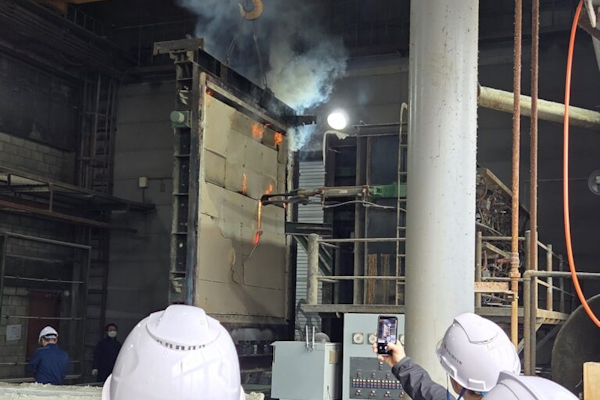
CWK also engaged Dr. Steve Craft of CHM Fire Consultant Ltd. to strengthen the fire testing approach. Through a combination of virtual consultations and an in-person visit to Korea, Dr. Craft provided expert guidance on assembly design and test preparation. A pilot fire wall test conducted at FILK on February 27, 2026 successfully achieved a two-hour fire resistance rating, providing an important proof point and reinforcing confidence in the system ahead of full-scale certification.
Full fire and acoustic certification testing is planned for FY2026–2027. Once completed, this work is expected to remove one of the key barriers to wood adoption in Korea’s mid-rise multi-family sector and support broader market acceptance among developers, builders, modular companies, and public housing stakeholders. Interest from organizations such as LHRI (Korea Land and Housing Research Institute), along with growing attention from modular construction firms, suggests the market is increasingly ready for technically validated wood solutions.
By focusing on certification, CWK is helping shift wood construction in Korea from a niche demonstration market toward scalable adoption in mainstream residential applications. This is a strategically important step in expanding wood use in South Korea, particularly in the mid-rise multi-family segment where the long-term growth potential is strongest.
Source: Canadian Forest Industries