




Growing Canadian Dimension Lumber Use In Post And Beam Hybrid Applications
Growing Canadian Dimension Lumber Use In Post And Beam Hybrid Applications
Sometimes market progress begins with something quite simple: solving a practical problem.
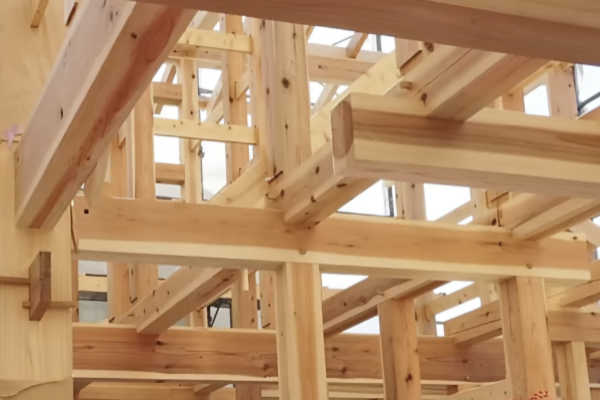
In Japan’s housing industry, one of the most common building methods is zairai, the country’s traditional post and beam system. In broad terms, zairai homes are built around a framework of posts, beams, and columns, rather than the platform frame system more familiar in North America. It is a long-established method in Japan and remains widely used, valued for its flexibility in design and its strong fit with local building practices.
That said, once dimension lumber is introduced into post and beam hybrid applications, things can get a little more complicated.
This has become especially relevant since Japan’s 2025 Building Standards Law revisions came into effect, requiring structural calculations as part of the residential permitting process. For standard zairai component sizes, that process is already well understood by architects and designers. But when hybrid designs incorporate dimension lumber, the path is not always as straightforward.
That is where Canada Wood Japan’s Technical Manager Yusuke Neriko has been helping to move things along.
Through market outreach to Tatsumi Co., Ltd. — one of Japan’s leading metal connector and pre-cut manufacturers — Neriko introduced Canada Wood’s third-party voluntary evaluation and structural calculation tool, which allows Canadian dimension lumber sizes to be specified in post and beam horizontal diaphragm applications. In other words, it helped turn what had been a technical complication into a workable option.
And in this business, that small shift can go a long way.
As a result, Tatsumi has now adopted dimension lumber in part of its structural pre-cut package lineup for homebuilders. It may sound like a modest step, but it is a meaningful one. Once a product finds its way onto the specification menu, it has a far better chance of gaining real market traction.
The timing is also favourable. As Japan’s newer energy-efficiency requirements push builders toward thicker insulation and more robust assemblies, Canadian dimension lumber is well suited to the job. That is particularly true in colder northern regions, where better thermal performance is more than a selling point — it is simply part of building well.
So while this may look like one company story on the surface, it points to something broader: with the right technical support, a clear explanation, and a bit of patience, Canadian lumber can find new opportunities even in parts of the market that may at first seem difficult to access.
Source: Industry News