





PG Bison steams ahead on the promise to meet MDF (SupaWood) demand in Southern Africa and beyond
PG Bison steams ahead on the promise to meet MDF (SupaWood) demand in Southern Africa and beyond
 Components of the new PG Bison MDF Contiroll plant are assembled on site
Supply of locally produced medium-density fibreboard (MDF) in the Southern African market has been constrained for many years. That is all set to change in July 2024.
PG Bison's operation, situated just outside Mkhondo, formerly Piet Retief, in Mpumalanga, is in the spotlight.
With an investment of R1,875 billion, PG Bison's MDF Contiroll line investment in Mkhondo will bring its installed capacity of MDF up to a total of 1,190 cubic metres per day across its two MDF plants in Boksburg and Mkhondo. It will ensure that PG Bison can meet the growing demand for locally produced MDF in local and export markets.
RISING DEMAND
Urbanisation and significant growth in an aspirational, middle-income population is driving the need for increased and better-quality furniture and home storage solutions. The demand for premium furniture and cabinetry components with gloss, matt, and spraypainted finishes is increasing the demand for MDF even further.
The new MDF line and the recently completed particleboard line will position the PG Bison Mkhondo cluster on the map as a global powerhouse for producing wood-based panel products in Southern Africa. The manufacturing facility will soon be the only one in Africa to house a particleboard line, an MDF line, upgrade facilities, resin manufacturing and paper treaters on one site.
LOCALISATION
According to Gerhard Victor, PG Bison's CEO, the particleboard and MDF expansions will ensure that PG Bison remains a leader in the world-class decorative wood-based panel products.
"Our Proudly South African products are a viable and cost-effective local alternative to imports. They enable our customers to keep lower stock levels, which means better stock turns and improved cash flow, rather than tying up working capital in large tranches of imported products.
And the products have significantly better lead times than importing, so our customers can guarantee uninterrupted servicing of their customers' needs well into the future", says Victor.
A key consideration in PG Bison's investment strategy is localisation. PG Bison understands that without a thriving local industry, it would have minimal prospects in South Africa.
 The board curing and cooling production unit at the vast PG Bison manufacturing facility in Mkhondo
IMPORT REPLACEMENT
As trends evolve, end users look for newer and more exciting products. If PG Bison cannot supply the products needed to make those trends a reality, the demand does not go away. Instead, customers downstream turn to imports. And these imports are more likely to be finished products, putting many fabricator and installer jobs, within the local industry, at risk.
In line with the Furniture Industry Master Plan objectives, PG Bison's latest investment aims to replace a significant portion of the current MDF imports used in furniture manufacturing. It will enable manufacturers to replace finished goods imports.
EXPORTS
"While we continue to see an increase in local demand for our products, we have a growing export customer base that we must also support. As a key supplier to many businesses across the entire value chain, we are responsible for continuously innovating and ensuring that we remain globally competitive to support our customers' growth, locally and internationally, and ensure the industry's long-term sustainably," explains Victor.
BOKSBURG AND MKHONDO
PG Bison’s Boksburg plant has been the company's only MDF site for many years. When the time came to green-light investment for another MDF line, Mkhondo was chosen as the preferred site. The decision was based on the site's proximity to raw materials, fibre and resin. These factors greatly assist in managing input costs and improving overall competitiveness.
Although there have been rumours regarding the future of the MDF plant in Boksburg, PG Bison is adamant that it has no intention of mothballing it. The company will produce MDF at two sites as it already does with its particleboard. The Mkhondo and Boksburg plants are well-placed to serve the growing MDF demand across PG Bison's local and export markets.
Site preparation for the MDF expansion project at Mkhondo began in April 2021, with construction and installation following in March 2023. Victor confirmed that the commissioning of the 273,780 m3 plant will commence in February 2024. Local and international customers can look forward to an "uninterrupted local supply of MDF" by July 2024.
ECONOMIC GROWTH
As a corporate citizen of South Africa with a vested interest in the country's economic growth, PG Bison believes the forestry and broader furniture manufacturing industry's well-being is paramount. By extension, expanding manufacturing capacity helps increase business growth and employment opportunities across the value chain.
"We are in the business of inspiring and enabling beautiful living spaces", explains Justin Berry, marketing and strategy development executive at PG Bison.
ASPIRATIONAL DESIGNS
"A part of that is ensuring we offer products that meet our customer's needs. Another part is stimulating demand throughout the channel. People are looking for more aspirational designs and products, and we need to facilitate that by exposing more people to what is possible.
"Our proactive participation in Proudly South African, the South African Furniture Initiative (SAFI), and the Kitchen Specialists Association (KSA) confirms our commitment to the industry", comments Berry.
He says the business has "taken a very active role in establishing the Furniture Industry Master Plan and the Forestry Master Plan. We are doing our part to facilitate local employment and economic growth.
"An objective is to help reduce imports in furniture and increase input materials that are locally produced. It will assist in increasing economic opportunities for local businesses and save the African continent's valuable foreign exchange.
"While the intention of the Furniture Industry Master Plan includes motivating South African businesses to source and produce locally manufactured furniture, it also aims to stimulate exports in the Southern African and broader African markets, particularly in the context of the African Continental Free Trade Area (AfCFTA", explains Berry.
FUTURE PROOFING
Berry says PG Bison is helping to future-proof Southern Africa's furniture, building and construction industries by investing in capacity to support the growing demand for quality, decorative products in Africa.
"The sharp increase in home improvement activities spurred by the Covid-19 lockdowns in 2020 and 2021 has steadied. However, we anticipate the work being done by governments across Africa on the AfCFTA and the growing demand for interior decorative solutions across the market will drive demand for PG Bison products into the future", he says.
The glue that binds PG Bison
PG Bison's WoodChem factory, lying adjacent to its particleboard and upgrading facilities in Mkhondo, Mpumalanga, is the largest urea formaldehyde (UF) and melamine formaldehyde (MF) resin producer and the only melamine paper treatment plant in sub-Saharan Africa.
The resin plant supplies UF resin to PG Bison's two particleboard plants in Mkhondo and Ugie and its MDF plant in Boksburg. Another resin the plant provides is urea and melamine formaldehyde syrup for treating raw decorative paper.
Tamaryn Whittal-Steynberg, manufacturing executive at PG Bison, says, "Manufacturing melamine syrup is a value-adding extension of WoodChem's processes. We own more of our value chain, which increases our business’ production flexibility and allows us enhanced production quality control".
WoodChem has built a strong reputation over the last two decades through its quality products and service excellence with internal and external customers.
The chemical plant houses two international reactor plants, one established in 2001 and the second in 2015, with an annual capacity of 123 kilotons of resin and 77 kilotons of formaldehyde.
The paper treatment plant houses two European-manufactured decorative paper treater production lines with an annual capacity of 80 million square metres. The lines take raw decorative paper and pass them through resin baths and rollers to ensure the paper is correctly dosed and evenly saturated with resin before drying in air flotation drying tunnels.
The treated decorative paper is then slit, wrapped and despatched to PG Bison's seven melamine presses. The process helps PG Bison remain flexible and responsive to the increasing demand for melamine- faced boards (MFB) across all its markets. "WoodChem adds value to PG Bison. We are the glue that binds the business. No other company in sub-Saharan Africa can produce melamine-treated paper. Other producers of MFB in the region must import treated paper at great cost", explains Whittal-Steynberg.
"By importing and stocking the décor paper in its raw state, we can resin-treat it in the required volumes on demand. It greatly reduces the risk in our supply chain, as we do not need to carry significant volumes of treated products with a limited shelf life, but rather keep the decorative paper in its raw state as that has a much longer, useful shelf life.
"PG Bison continues to be exemplary in constantly seeking innovative ways of doing business by adding value to their customers and shareholders, which will positively impact the greater economy".
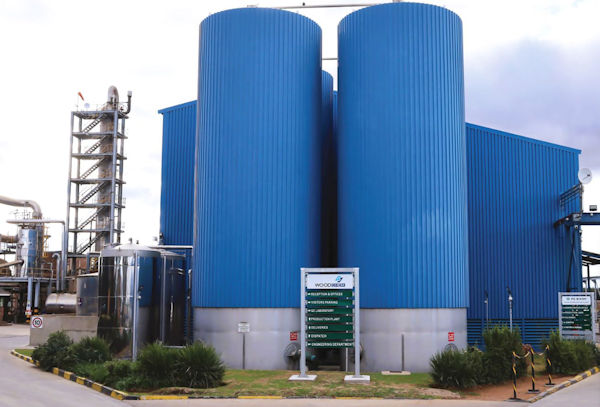 PG Bison's Woodchem plant in Mkhondo
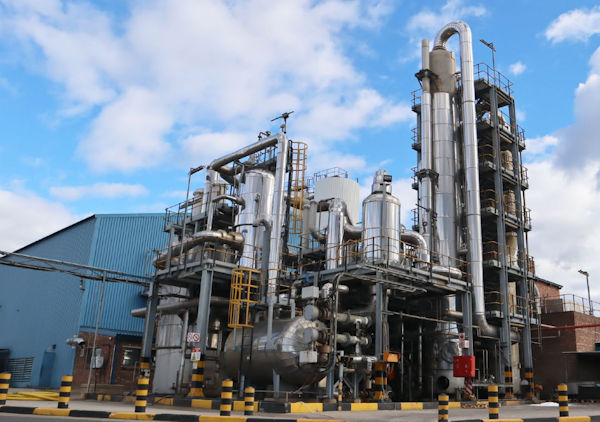 The Woodchem plant is the largest UF and MF resin producer and the only melamine paper treatment plant in sub-Saharan Africa
Source: WoodBiz Magazine (Pages: 6 – 9)