




Prefabs add value to timber
Prefabs add value to timber
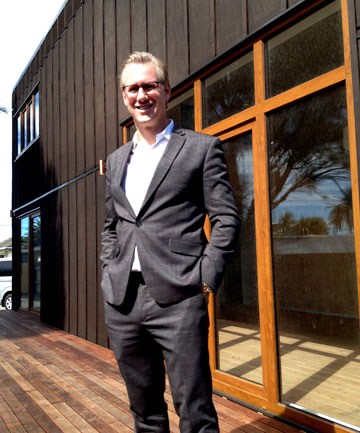
"Welhaus director Dan Tremewan by his first Beach Barn house,
built of panelised engineered timber, in North Beach, Christchurch."
Exporting timber houses makes more economic sense than exporting logs.That was Dan Tremewan's thought, as he watched, from his Lyttelton home, logs being stacked at the port below.
Four years of thought later, the Christchurch property investor and developer has unveiled Welhaus, his own brand of modular, engineered timber homes.
Based on what he had seen in Europe, he has developed the concept in several low-energy designs. The first example has just gone up in seaside North Beach.Others are planned for Huntsbury and Lyttelton, with more orders on the books.Realtor Harcourts will market the homes locally and Tremewan is investigating national and offshore markets.
"We should be able to ramp up production to a couple a week and we're looking at the export potential for next year," Tremewan said."I think we've got something quite special and if we can do it in enough volume, it's an answer to New Zealand's low productivity in house building. And it uses technology to add value to our wood."
The name is a contraction of well-being and the German word for house.
While New Zealand has companies making prefabricated or modular homes, Tremewan believes his concept has "a lot of firsts". The first to combine factory-built panelised housing and a swift eco-build. The first to do modular homes with lightweight timber panels and laminated solid wood; and perhaps the quickest to put up.
Tremewan developed the concept with fellow Lytteltonian and architect Simon Blencowe, Christchurch-based German-trained engineer Johann Betz and various architectural designers.
All the homes use New Zealand-grown timbers, such as pine and douglas fir, made into cross laminates and engineered plywood, and the panels are insulated with New Zealand wool. Every piece is factory made - the walls in a Christchurch factory, and the floors and ceilings in Nelson.
Styles range from family-sized to studios, including hillside dwellings, beach houses, mobility-accessible studios, plus apartments. Some designs can slot together to make a bigger home, or be built above a garage, form terraced housing separated by courtyards or carports, or slot into a frame to make multi-level blocks.
They pack flat into shipping containers and ship "surprisingly inexpensively", Tremewan said. Designs are flexible to cater for buyer customisation and building codes in various jurisdictions, including post-disaster zones. Partner builders offshore would assemble them at each location.
The Beach Barn, the style built at the North Beach site, has three bedrooms but is compact enough to qualify as a secondary dwelling on a shared section. The house went up in three days during September - although Tremewan believes it could be done in one - and finishing took three weeks.
The Beach Barn would cost a customer $229,000. Extra are foundations and land costs.
Tremewan has a background in finance and property development.
"We wanted something that's attainable in terms of price. The word affordable gets bandied around a lot - but what does it mean?"A complete factory build would avoid the "associated delays, wastes, hazards, lack of precision and inefficiencies" of traditional on-site building."It makes sense to spend the money on the structure of the house, because that's the thing that has to last," he said.
While the manufacturing is being done on contract now, Tremewan may establish his own factory, either in Christchurch or Wellington. Another plan is to enter design competitions, aiming for recognition to help boost their profile.
The concept meant local manufacturing, design and engineering jobs, as well as offshore income for New Zealand skills and materials, he said."This is really something for Kiwis to take on."
Source: Fairfax Media