




Q & A: Marcus van der Hoven discusses Mass Timber Technologies
Q & A: Marcus van der Hoven discusses Mass Timber Technologies
 Marcus van der Hoven
Marcus is the 31-year-old co-founder and managing director of Johannesburg-based Mass Timber Technologies (MTT), which he describes as "A progressive and innovative business based on design for manufacturing and assembly (DfMA) engineered timber solutions for the built environment".
In an interview with WoodBiz Africa, he says the market for timber structures is slowly emerging across Africa. With a lighter carbon footprint and lower energy consumption of any building material in its life cycle, timber construction methods are quicker and simpler, leading to a cost-competitive building product.
"We have to accept that it takes over 20 years for trees to grow. Being an active part of the forestry economy teaches us the value of learning from people who have been in it for a long time. It involves thorough research and development, health and safety standards, and precision in design and manufacturing.
"Driving new technology into the sector has been met with hesitation, but as we begin to see larger projects materialise, we are fostering confidence and more involvement from primary producers", he comments.
MARCUS, HOW DID YOU GET INTO THE TIMBER INDUSTRY?
Africa's population is growing, with the UN predicting that it will reach close to 2.5 billion by 2050, and buildings will always be needed. While studying architecture, much of my honours and masters research work included integrating timber elements beyond decking and facades.
Instead of going into architecture, I established a furniture factory that ran for about five years, which, in turn, evolved into the early stages of MTT as my interest turned to mass timber. I visited factories in Austria,the impressive Binderholz in Germany and others in Europe. I also met Jamie Smily, who I consider the pioneer of cross-laminated timber (CLT) in South Africa, who showed me his facility in Cape Town.
My research confirmed that the South African engineered timber market, in its current state, will not support international players setting up engineered timber factories in their typical "European" form. I saw a gap in the market for a stepped development. Accessing quality timber and innovating digital and technical skills, MTT is responding to a growing market and adapting its structure as the niche market accepts more volume.
While setting up the business, I met Anthony Lewis, CEO of the Sustainabuild Group, and we found that we shared a vision and understanding of the African construction market. Anthony introduced me to Boxa Possibilities, a business focused on designing and manufacturing modular auxiliary dwelling units, and we decided to collaborate to get cross-laminated timber (CLT) structures into the market.
TELL US ABOUT YOUR BUSINESS MODEL.
MTT specialises in DfMA and manufactures prefabricated timber components and structures for on-site assembly. We work with architects, engineers, quantity surveyors and builders to manufacture solid timber panels, beams and columns.
CLT and the concept of mass timber have a long way to go in SouthAfrica, and we need more information to be freely available to designers and engineering professionals.
We published the MTT Design Guide, which is free to download off our website and walks design professionals through understanding wood and working with mass timber. We are already working with several architects who want to push the boundaries of sustainable design and construction.
We are currently looking at projects in urban densification. As you know, the demand for living space in cities is high. With high land costs, adding additional levels to existing builds is an excellent solution for extra density and extra building value. It is too costly to increase foundation systems to bear the extra weight of concrete, and we propose that mass timber be the solution.
We also produce many private homes, new and upgraded commercial properties, and resorts. In the last year, we have shipped complex timber structures to remote places in South Africa, Rwanda, Kenya, Zanzibar and elsewhere in Africa.
 The four-storey building in Cheichei takes shape
WHAT DO PROJECTS LIKE CHEICHEI IN ZANZIBAR ENTAIL?
In phase one of our business, we worked hard to get the fundamentals around the business model, costs, marketing, quality resources and a channel to market. The Boxa units gave us a good start. As interest grew, we worked on several projects before landing the CheiChei project.
We were tasked with manufacturing a four-storey mass timber building for the CheiChei Living project in Fumba Town, Zanzibar. It is Africa's first CLT hybrid structure with more than two levels.
The entire prefabrication process happened digitally. It was a collaboration between the architect in Germany, the client and builder in Zanzibar and us in South Africa.
This modern process uses building information modelling (BIM) software and good communication to ensure everyone, including the on-site workers, understands and agrees with the final designs. The CheiChei team never met during the design and fabrication phases.
When everyone signed off on the design, we manufactured over 1091 components, complete with detailing, packed them into five 40-foot containers and sent them to Zanzibar, where they were assembled on-site.
IS YOUR FACTORY IN JOHANNESBURG FULLY AUTOMATED?
No, it isn't, and we don't want it to be. We use automation where precision is important, but we also want to keep involving people. We believe in creating jobs and balancing digital processes and manual skills.
In the factory, everything revolves around the press. We bought an old press that was going for scrap in KwaZulu-Natal and shipped it to Johannesburg to rebuild it into our "Franken" press. We apply adhesive under controlled conditions, lay up the sawn lamellas, and apply pressure on six sides to form large panels. Our first panel certainly had its issues, but we were excited, as it represented the beginning of realising our vision. We have processed over 750m3 of certified CLT through the press.
ARE YOU CONTINUING WITH RESEARCH AND DEVELOPMENT?
Constantly. We must ensure that the design, detailing, and timber meet SATAS specifications. The lamination process is monitored continuously, with data capture and quality control measures in place to ensure that the product meets the strict requirements set out by the national standards.
We regularly send panels for testing at Stellenbosch University and the University of Pretoria. We work with SATAS to ensure the timber is stress-graded for structural application.
There's a lot of innovative work happening in timber engineering at the Universities of Pretoria and Stellenbosch. They are doing incredible work for the forestry industry by researching and testing adhesives, acoustics, moisture content, treatments, finishes, local timber properties and species, detailing and structural testing. We strongly believe their work will benefit the entire value chain and are proud of the partnerships between industry and academia.
WHY IS TIMBER CONSTRUCTION SLIGHTLY MORE EXPENSIVE THAN A "TRADITIONAL" BUILD?
It really depends on the size and complexity of the project. When designed correctly, there is not much more than a 5% premium on a masstimber structure. And don't forget, this is just the structure, before finishes, facades, furniture, etc.
There are also extraordinary savings in construction time, with timber buildings going up in a fraction of the time of a "normal" build. Hotels, tourist resorts, homes, offices, schools and additional levels can be erected rapidly and safely. No water is required on-site, and no rubble or builders' mess to clear up. Engineered timber sequesters carbon, which is a serious consideration in the project design phase.
ARE THERE ISSUES WITH INSURANCE, WOOD ROT, BORER BEETLES, AND MOISTURE?
There's no reason for insurance companies to refuse cover and banks to refuse loans. There is a national standard for CLT, and, like all construction projects, buildings must be signed off by the legislated responsible persons, so we have not experienced any additional premium when insuring a timber structure. Fire safety is top of mind, however local and international fire and timber engineering experts have repeatedly laid the issue to rest.
Mass timber structures are explicitly designed to handle the required fire ratings. Much like any other material used in construction, engineered timber has very predictable characteristics in fire conditions, making it fairly straightforward to design.
On the other hand, water and pests are wood's biggest enemies, and we advise using vapour barriers and preservation treatments on our panels. Correct detailing for engineered timber structures stops water from moving into the structure while allowing vapour to pass through and maintain a state of equilibrium.
In South Africa, standards specify that structural timber in some areas be pressure-treated with wood preservatives like CCA (chromated copper arsenate) to protect it from pests like borer beetles. However, there is no pressure vessel large enough for a full-size CLT panel, and, besides this restriction, we did not want to use CCA. After consulting wood scientists about alternative treatment options, we have opted for a boron-based surface-applied product and are exploring some less toxic preservatives and treatment techniques.
DO YOU SOURCE YOUR WOOD FROM LOCAL SAWMILLS?
All the material we laminate is sourced from local, well-managed forests. Most of our processed volume is SA Pine, which performs well structurally and is cost-effective. Our products look and perform very similarly to those in Europe and the USA. Our national product standard for CLT is based on the American ANSI code, which aligns well with the standard required to participate in the international market.
I think there is very little wrong with the timber resources we have available in South Africa. Most of our forests and sawmilling operations are FSC-certified, and our local timber is produced to very high standards. We believe this resource is primed for value addition. How we develop technologies to participate in more valuable markets and collaborate as an industry remains to be seen.
With construction and the country moving through its typical cycles, we remain optimistic that development and construction will return as a considerable market force. Our intention at MTT is to position our capabilities to participate meaningfully in that market.
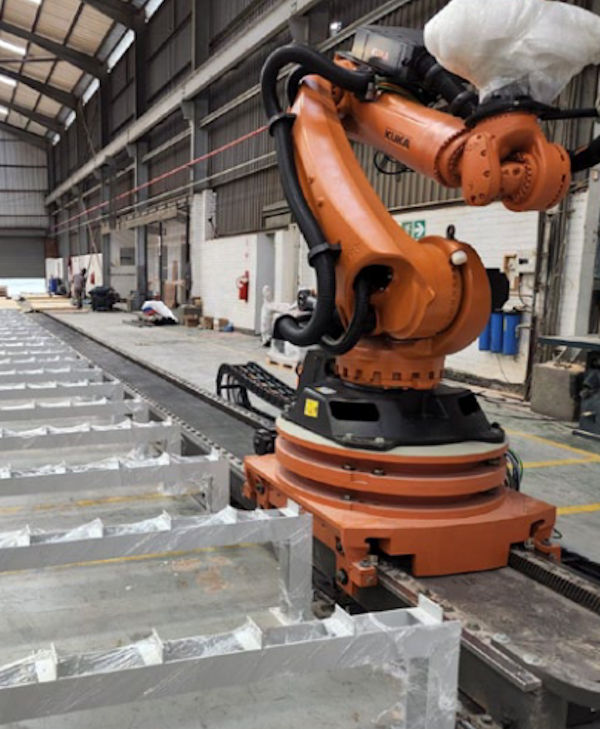 MTT's Kuka milling robot reports for duty
MARCUS, WHAT ROLE DOES MTT PLAY IN THE FORESTRY SECTOR?
Mass timber structures in South Africa are based on a localised value chain where everything is done without exporting and reimporting resources. The sector provides thousands of jobs and stimulates local economies and SMEs.
We consider ourselves a new link between the construction, forestry, and sawmilling industries. Mass timber's technical and aesthetic advantages as a commercial solution to complex building problems provide an appealing and efficient alternative for architects, engineers, wood scientists, foresters, and sawmillers.
The digital world is opening the sector to new ideas, alternative construction methods and ways to solve problems. Value-adding is no longer about producing pine shelving and basic decking profiles. It's about unleashing the power of wood to improve the built environment.
WHAT ARE YOUR PLANS FOR THE NEAR FUTURE?
CLT is a wonderful product, but it is not a silver bullet to solve complex urban problems like mass sustainable housing. The immediate future lies in hybrid multi-storey construction incorporating concrete and steel. There are high financial and carbon expenses attached to heavy concrete floor slabs. CLT is the lighter, quicker, and greener alternative. We are challenging the construction and sawmilling industries with new and more efficient ways to add value to timber.
We had to develop our technology with limited resources during our first phase. However, MTT forms part of the Sustainabuild Group of companies, which provides a solid platform for us to continue our expansion and advocate for more timber construction, locally and internationally.
Earlier this year, the group closed a significant funding round with Criterion Africa Partners, which has allowed MTT to increase output and introduce several new products into the market.
We are expanding. We recently commissioned a robotic CNC cell and are waiting for our new finger-jointing system to be installed in Q3 of this year. At the moment, the factory is producing comfortably between 100 and 150m3 of mass timber per month for projects that are currently active. When we introduce advanced manufacturing technologies and a new range of glue-laminated products, we expect to increase monthly throughput to 300 m3.
MARCUS, WHAT ADVICE DO YOU HAVE FOR YOUNG PEOPLE LOOKING FOR A CAREER?
Consider a career in timber. Pay attention to how timber is and is not currently used and where it can be applied most effectively. Timber is the only natural resource that ticks all the right boxes. It is the only socially acceptable, renewable, recyclable and carbon-sequestering material. We shouldn't let this opportunity slip through our fingers.
Get excited about an industry that combines the latest digital developments with natural materials to design and manufacture fantastic shapes and forms. I think forestry and sawmilling struggle to attract innovative thinkers due to misunderstood perceptions of the industry. There is massive potential for the youth in this sector.