




The 2024 annual wood conference confirms the role of timber in constructing Africa's cities sustainability
The 2024 annual wood conference confirms the role of timber in constructing Africa's cities sustainability
 An avid audience attended the 2024 annual Wood Conference
Nearly 600 built environment professionals, academics, students and members of the forestry and timber industries were joined by an online audience of over 250 from all over South Africa to attend the Kuratle Group's 13th annual structural timber-focused Wood Conference in Cape Town.
George Kuratle, the founder of the Wood Conference, may use a wheelchair; however, he is a leading presence at each event. He passed the hosting baton to his son Roger, the third-generation CEO of the Kuratle Group.
KURATLE TRADITION
In his opening remarks, Roger Kuratle briefly sketched the context of the volatile world where territorial conflicts, nations at war, hate and despair and the climate crises dominate the headlines. He commented, "A big part of the world seems to have lost the basic understanding of respect and acceptance that the cultural differences in our societies make us unique".
Still, he said, "As a family company, we try to set an example of doing things differently. We believe that with respect for others and generosity of spirit, it is possible to help the world become a better place, regardless of contribution size. We are making a difference because we aim to promote timber as a sustainable building material for urban and rural towns and cities".
An indication of the high regard for the Kuratle Group in the global construction industry is that only one of the nine international speaker delivered a virtual presentation. After Markus Thür, the Consul General of Switzerland, welcomed the 500 delegates and over 250 online attendees in Cape Town, Hannu Garny, the entertaining master of ceremonies, took over the reins. He ensured everything ran smoothly and the 13 enthusiastic subject matter experts did not run over time.
First up was Thomas Kaestner, the operations manager at Hector Egger Holzbau in New Zealand. He described the country's weather and environmental conditions favouring mass timber construction. A key consideration when planning buildings is to design for earthquakes by incorporating specialised connectors.
Technology like design for manufacture and assembly (DfMA) is essential. He warned architects and engineers that "you may be able to draw the plans of a building, but it doesn't mean it can be built. Don't make assumptions, think, plan then build".
Kaestner's explanation of the careful planning it takes when working on public spaces like an airport was echoed by Pirmin Jung. Pirmin is a certified timber construction engineer and owns the Switzerland-based engineering company Pirmin Jung. He presented some challenges the company is solving while replacing the 35-year-old Dock A at Zurich Airport.
The project took over ten years to plan, with construction occurring between 2027 and 2033. The new dock, which is consuming over 42,000m3 of wood, is being built while the old dock is still operating.
Jaakko Paloheimo, the sustainability manager of UPM's Wisa Plywood in Finland, spoke about the role of environmental, social and governance (ESG) in corporate sustainability risks. "It is not enough to 'bolt' sustainability onto a project. You must make it real to your employees, be transparent and use experts to assist you," he said.
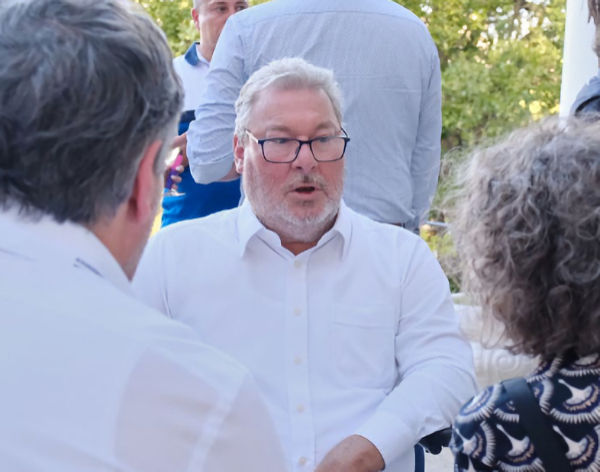 George Kuratle initiated the Wood Conference
"Construction is a face-to-face industry. You must understand the client and educate them about environmental product declarations(EPD), the advantages of wood over fossil-based materials and fuels, life cycle emissions and the importance of sustainable behaviour".
The next speaker was Duncan Harrison, a Stellenbosch University graduate and a senior consultant with Arup in Australia. He called for a "uniquely African approach to mass timber projects" that instils pride within communities. "By 2050, one billion people in Africa will live in cities. The government needs a new mindset. Instead of asking why it should be built of wood, they should ask why it can't be done with wood".
Like speakers before and after him, Duncan emphasised the importance of using technologies like 3D modelling and digital twins when designing and planning buildings. The planning and detailing do not stop on the drawing board. It includes considerations like moisture content, recyclability of materials, site accessibility, lead and delivery times and how to load materials on the trucks.
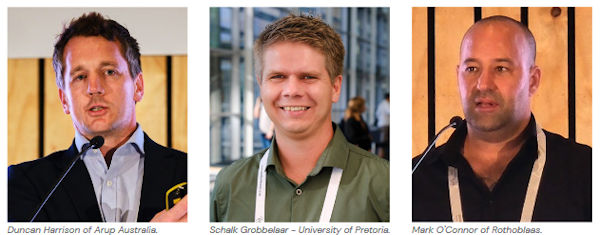
Dr Schalk Grobbelaar, a senior lecturer at the University of Pretoria, picked up where Harrison had left off. He said South Africa doesn't have the time to reinvent the wheel when transitioning from concrete to timber. "We attend conferences like this and learn and adopt standards from the rest of the world. But we can't just copy and paste. Most clients and countries building with wood are wealthy. Not all their solutions can work in Africa, where we need to apply frugal innovation to find cost-effective modular housing solutions", he remarked.
Schalk said his department's approach to teaching architecture and engineering lecturers and students about timber construction using design thinking and protobuilding. The multi-disciplinary, hands-on, and team-building approach across tertiary institutions was popular with the conference audience.
Mark O'Connor, the area sales manager of Rothoblaas, described the challenges and technicalities of introducing mass timber to the traditional construction sector in Africa. He said difficulties like durability, air and watertightness, fire ratings and standards are relatively easy to overcome.
However, when architects, engineers, quantity surveyors and clients accept timber as a building material, the focus shifts to the contractors. Contractors must understand the detailing, specialised tooling and skills needed on a modern building site.
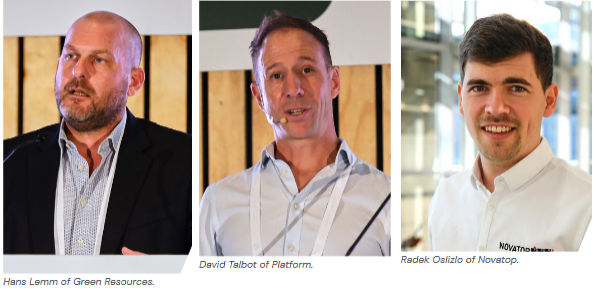
Hans Lemm is the Group CEO of Green Resources. This Norwegian company manages 38,000ha of plantation forests in Mozambique, Tanzania and Uganda. It operates two sawmills, three pole treatment plants and a briquetting plant.
Hans asserted that sustainability in Africa is not about "how can I be carbon neutral". Rather, "plantation forestry is an economic growth engine. We need to create jobs outside the cities because African cities will not cope with the influx of people.
"We are talking too much about the carbon impact of construction. We should be talking about Africans extracting value from forestry and sawmilling products and residues to grow wealth and provide rural communities with employment, sustenance, health and education services. Hans described the value of biochar, affordable housing and carbon credits.
Radek Oslizlo, the head of development and technical manager at Novatop in the Czech Republic, discussed the aesthetics of mass timber construction. The company designs and manufactures three-layer Novatop SWP panels and the Novatop cross-laminated timber (CLT) System.
Radek said one of the biggest disadvantages of CLT is its surface quality. The size of the panels and the risk of damage during transport and assembly make it difficult to sand and finish. Novatop's solution is to clad the CLT with its visually appealing and easy-to-finish SWP panels.
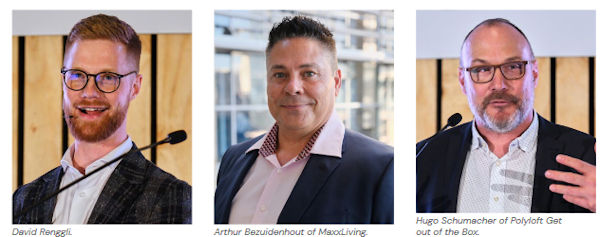
David Renggli, CEO of the Swiss company bearing his name, discussed the challenges and opportunities in opening up new timber construction markets. His company is building Germany's largest factory for manufacturing multi-storey modular timber homes and components.
David's advice for developing new markets for structural timber include selecting financial and ownership partners and employees carefully, building capacity and scalability, adapting instead of copying because all markets are different, preparing for volatility and uncertainty, "tell and sell a compelling story", and "rethink everything even if you end up where you started".
The president and CEO of Maxxliving, Arthur Bezuidenhout, presented South Africa's first self-sustainable, off-the-grid, prefabricated modular timber homes development, Country Gardens Estate in the Mogale City municipality in the Gauteng West Rand. The development and homes meet all necessary legislation and standards. There are three customisable home sizes to choose from that are constructed and assembled on-site between 20 and 40 days later.
The Swiss speaker from Polyloft, Hugo Schumacher, told the audience to get out of the box now! He presented the Polyloft system comprising six wooden surfaces, each 2,5m long, connected with a specially developed hinge to create a hexagon. Two surfaces form the walls, two are the roof, and two point downwards to form the floor. Additional supports from the outside and an inserted floor hold it together.
David Talbot walked the audience through an architect's perspective on designing a timber house that met his client's specifications and pocket. He needed to create a modern timber "treehouse" home that blends with it natural surroundings in picturesque Bettys Bay in the Western Cape. He worked closely with the suppliers and the result was an undulating home built with CLT from XLam, and a free-formed curved glass wall suspended on a steel structure and clad in a thermally modified wood product, Lunawood.
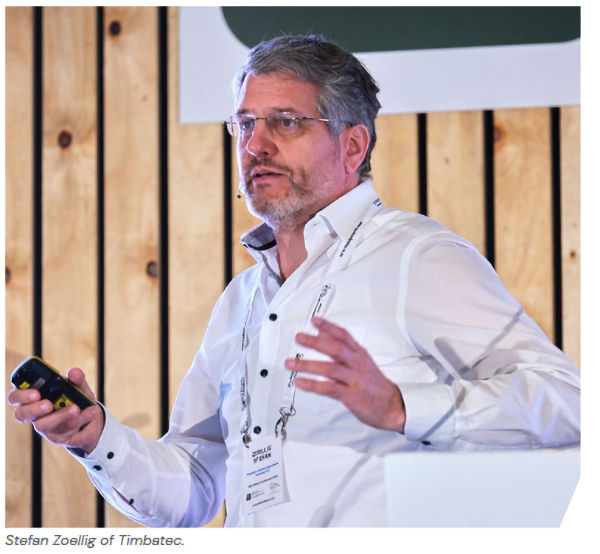
Stefan Zöllig, founder of the Swiss company Timbatec, presented a novel product for large-scale timber construction. After ten years of research and over 2,000 tensile and bending tests, the TS3 technology is ready. With TS3, floor slabs distribute loads in two directions and span columns in an 8m x 8m grid. The product can do everything that concrete can do. The TS3-treated CLT panels are edge-jointed with special grouting without pressing or other
connecting means.
GROWING
Event organiser Zaida Davids of HWZ International said the Kuratle family were pleased when their first conference 13 years ago attracted 90 people in a hall that could accommodate just over 100 people at a squeeze.
"After the third conference, we moved to the larger venue in the Cape Town International Convention Centre (CTICC), and the conference grew to over 900 attendees before Covid. The response to this year's event confirms that the Wood Conference brings together the best of the best presenters and attendees to gain knowledge".
Source: WoodBiz Africa - February 2024 Newsletter (Pages 32 - 35)