





Turning Toronto’s felled trees into lumber

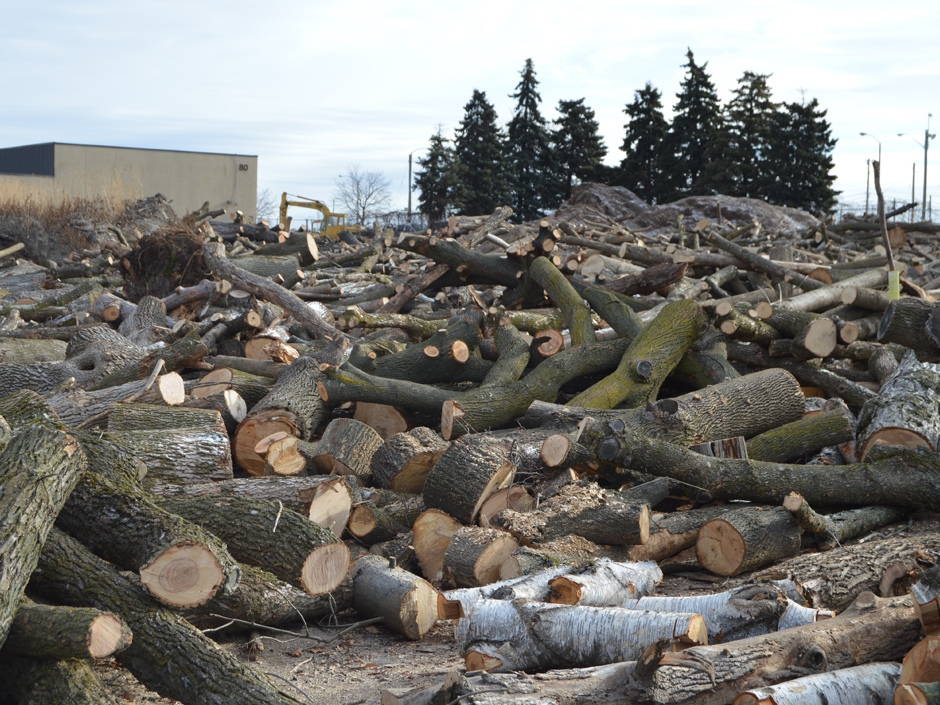
Someone has finally realised the 20 000 trees Toronto cut down last year could have a better fate than mulch. In the days of ‘Muddy York’, before it became Toronto, sawmills speckled the local landscape, sawmills lined the Don River, for instance, in Todmorden Mills near what is now Pottery Road and in York Mills, drawing their power from the Don River.
In January, for the first time in perhaps a century, a sawmill once again started up in city limits to mill Toronto trees into lumber, at the City of Toronto Nashdene Public Works yard, near Finch Avenue East and Markham Road in the far northeast reaches of Scarborough.
Hills of felled ash logs cover this yard. Peel off their bark and you see why; fine squiggles cover the wood, tracks from the emerald ash borer, an invasive insect devastating our ash trees. Crews contracted by the city cut down 20 000 city trees last year, including 13 000 ash trees. Once the logs get here, contractors grind them into woodchips, which costs $8 a ton. The contractor uses some wood chips for mulch. Often the city pays another $100 a tonne for haulers to take the chips to landfill.
Surely this is madness. Trees are a resource. And now someone has figured that out.
In one corner of the yard, ‘Sawmill’ Sid Gendron and his daughter Sasha Gendron, lift an ash log the diameter of a telephone poll onto a portable red sawmill. The mill’s blade, a band that spins on two spools, whirrs to life. Gendron slowly pushes the saw through the log. In a few minutes he has cut a plank, boarded by what connoisseurs call a ‘live edge’ of rugged bark.
“These logs are phenomenal,” says Gendron. And this is not just reuse; when Gendron cuts a tree for planks, he saves the city up to $108 a ton.
“Forestry wants to get rid of the trees as cheaply as possible,” says Rob McMonagle, a senior advisor in the city’s Green Economy division. “It’s 50 000 tonnes of dead trees that the city has to process.”
After last year’s ice storm, Toronto ground huge quantities of old-grown beech, oak, maple, ash and other logs into chips. McMonagle called that a waste, saying, “We should look at trees as we look at a side of beef. Every part has value.” Not long after, Gendron approached the city to reuse the logs. Though no money is changing hands, McMonagle worked months to arrange the pilot project.
“We’re open for business,” he says. “You submit a proposal, we will look at it.”
Sawmill Sid sold two truckloads of ash lumber he milled in Scarborough to Weston Forest, a Mississauga company. Weston Forest supplies lumber to steel makers and equipment manufacturers for skids, pallets and crates to pack machinery.
“This feels like a good use of an existing resource that otherwise would be chipped or turned into mulch,” says Dustin Wood at Weston Forest. “Otherwise we would be using logs that are felled in the forest.”
City trees, because they face different stresses than forest trees, often produce lumber with twisted and unusual patterns in their grain.
“These trees are subject to unique conditions,” says Wood. “The pieces we get out of it can be quite beautiful.” He sees opportunities for high-end furniture, tables or kitchen islands.
Chris Tucker at Classical Displays furniture builds benches for Toronto parks using recycled plastic. He visited the mill in Scarborough and sees opportunity. “We are now going to be able to hopefully work out a deal to use lumber grown in the city and make benches for the city,” he says. “We can potentially keep that wood out of the chipper and have a bench with a story.”
One challenge: crews right now cut trees into six-foot lengths. For his sawmill, Gendron needs the logs cut eight feet, three inches.
But even the existing logs have a lot of appeal. He has put bids on three lots of city logs. In Scarborough, Gendron taps a two-ton oak log with his foot. Lying on its side, it is the height of a desk.
“This log would cost the city $200 to dispose of,” says Gendron. He can cut into 10 slabs and sell them, he says, for $450 each.
“We want to have a full-time operation in Toronto,” he says. “We could employ 22 people.”
Source: National Post (Edited)