





Use burnt trees according to their potential, says wood scientist
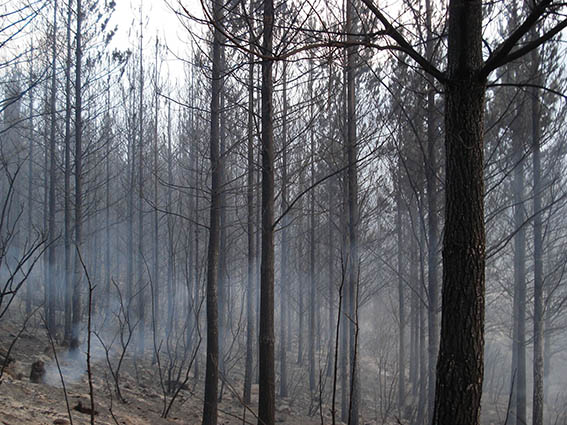
Jonkershoek post fire 2015
Photo: Martina Meincken
By Prof Martina Meincken, Department of Forest and Wood Science at Stellenbosch University
From an economic and safety viewpoint it makes sense to first determine the degree to which wood has been degraded during a plantation fire, before deciding what to do with it. While not all pine trees that have survived such wildfires should still be used to make roof trusses, they could be used to make furniture, flooring, fencing, pulp or as fire wood.
This is the message from wood scientist, Prof Martina Meincken, of the Department of Forest and Wood Science at Stellenbosch University at the recent symposium on silviculture and the management of dryland forests. It was held in Stellenbosch in March.
Her research group conducted a series of experiments testing the maximum temperature that South African pine wood can take before it deteriorates and is no longer usable.
Her research team is currently developing a non-destructive method with which to determine the temperatures to which wood was exposed during a wildfire. It can be used to decide on the end use of such wood. The project is funded by the National Research Foundation of South Africa.
The local sawmill industry follows one of two strategies when it comes to handling trees from plantations that endured a forest fire. Either none of the trees are used, which comes at a huge economic loss, or they are treated as normal wood.
“With the latter there’s always the chance that you might end up with several problems due to changes in the wood property,” explains Prof Meincken, who has done previous research showing how higher temperatures (as experienced during a veld fire) cause changes in the chemical, physical and mechanical properties of wood.
Research done by one of her students, Dr Benedict Odhiambo, showed that a tree’s bark is its best protection against heat and fire damage. The thicker the bark, and the more fissures or narrow cracks on it, the better its heat resistance and ability to protect the concealed wood.
“However, when the bark is exposed to a very hot fire for long enough, the wood behind the bark will inevitably be exposed to elevated temperatures and start to degrade,” Prof Meincken explains.
Little is known about the exact temperature at which changes to wood start to occur, and whether all tree species react the same. Therefore Prof Meincken’s team set about testing pine wood burnt at temperatures ranging between 150 and 350 degrees Celsius. This is typical of what is experienced during a forest fire. To better understand how heat affects the wood, it was viewed in detail using solid state Nuclear Magnetic Resonance (NMR) spectroscopy and computed tomography (CT) scanning.
The results clearly show that burnt pine wood, even if only mildly damaged, behaves differently from ‘normal’ wood and should therefore be processed in another way. This decline becomes especially significant at temperatures above 250 degrees Celsius. It becomes weaker and can break more easily when a load or pressure is applied to it. Also, the density of the wood and the thickness of the cell walls decrease along with increased temperatures.
South African pine wood is widely used to make roof trusses for the building trade. The wood should therefore be strong enough to hold up the weight of an entire roof. ”Our findings show that wood that has been exposed at temperatures higher than 250 degrees Celsius should not be used for such structural purposes,” she advises. “It no longer meets minimum strength requirements.”
Moisture content also comes into play in building matters, as wood that has not dried out correctly could shrink and cause deformation of the structures in which it is used. Therefore Prof Meincken’s team also conducted relevant experiments to see how the moisture content of pine wood changed after being exposed to high temperatures. When dried using a typical drying schedule of a saw mill, it was found to have a higher final moisture content than is usual after such treatment. Moisture content also varied much more within the samples than was the case with normal wood.
“This might be because the wood has already been partially and irreversibly pre-dried during the fire, which caused structural changes to the cell wall of the wood fibres,” she says. “The maximum temperature that a tree can tolerate before changes in its wood takes place will most likely differ from species to species,” believes Prof Meincken.
“We need to do more research to find out what this ‘cut-off’ point is for other tree species of economic value, so that we can know whether burnt wood could still be used as normal wood, if it should be processed in a different way, or not as structural wood,” she emphasises.
Source: University of Stellenbosch, Department of Forest and Wood Science (Edited)